Showing posts with label Apostle Paul. Show all posts

Tuesday, September 22, 2015

SYRIA - Hearts go out to the country of Paul's day


A zealot, Saul of Tarsus, in Jerusalem

In the first century when Jesus was born, a devout Orthodox Jew journeyed from Jerusalem's persecution of Christians to Damascus (Syria) to persecute more Christians. On the way the Lord confronted him. It was a conversion like all conversions to Christ--individual, unique, highly personal and transforming.

Paul, saved by God, goes to Arabia

Later, this man, once called Saul and then Paul as a devoted follower of Jesus Christ, went to Jerusalem and was not accepted by the apostles, because as Saul he had persecuted Christians.

He left for Arabia to study in what some call the school of the Holy Spirit. What was "Arabia" to Paul? N. T. Wright, in Paul, Arabia, and Elijah (Galatians 1:17) proposed that "Paul went where Elijah went. He went to Mount Sinai .... The word 'Arabia' is very imprecise in Paul's day, covering the enormous area to the south and east of Palestine; but one thing we know for sure is that for Paul 'Arabia' was the location of Mount Sinai."(See paragraph 11 in N.T. Wright article linked above.)

Mount Sinai, also called Mount Horeb, is on the Sinai Peninsula of Egypt. If N.T. Wright's reasoning is correct, that is where Paul went, that triangular, arid, desert region of Egypt, between the Mediterranean Sea and the Red Sea.

Paul travels back to Damascus

From Arabia, Paul returned to Damascus: "In the Galatian letter in 1:17-18 Paul clearly states that upon his return from Arabia he came back to the city of Damascus. Exactly how long Paul’s stay in Arabia lasted is not clear, but combined with his return visit to Damascus was a period of three years." (Tracing the Steps of Paul)

His visit to Caesarea, then Syria

Next, Paul went to Jerusalem, then Caesarea. Then, again, he went into Syrian regions:

"... Upon Paul’s departure from Caesarea, Luke tells us in Acts 9:30 that he was sent forth to Tarsus. It would be logical to conclude on the basis of his route that on his way back home to Tarsus this is when he stopped by different cities and visited brethren in the Roman province of Syria. Paul referred to this in Galatians 1:21." (Tracing the Steps of Paul)

Consider the capital, Damascus, then and now

Some say that Damascus existed 1,000 years or more before the birth of Christ, surviving takeovers by different empires. Three hundred years before the birth of Jesus, Damascus was a large Muslim caliphate. By the time of Jesus' birth, the Roman Empire ruled Damascus. 

After the crucifixion of Jesus, and when Paul met Jesus on the road to Damascus, as recorded in the Acts of the Apostles, he could safely travel into Damascus; he was a Roman citizen. Damascus in those days was a thriving city of architectural, artistic, and trade interests.

The Christian community across Syria is one of the world's oldest, going back to the days of the Apostles. "... and there are Christians of today that speak Aramaic. In northern Syria, near the city of Aleppo, the historic Church of St Simeon Stylites stood...in the mountains west of Homs is the castle of Krak des Chevaliers, which was a fortress for the Knights Hospitaller during the Crusades." The castle is now badly damaged, bombed by government jets after it was used as a base by rebels in Syria's civil war. (Middle East)


In 2015, in the Syrian province of Hassakeh in February, hundreds of Christians are feared to have been kidnapped by the militants. Senior Christian clerics have also been kidnapped by unknown gunmen. Suspicion for the abductions has fallen on the Nusra Front, al-Qaeda's Syrian affiliate. "While their community faces a clear threat from the extremists of the Nusra Front and Islamic State, Christian men have been fighting in the multi-layered conflict - either alongside Kurdish militias or alongside relatively secular rebel factions, or government forces." (Syria's beleaguered Christians)

Christian and Muslim Syrians 

The apostle Paul nurtured believers wherever he journeyed, including his travels through Syria. Christians today are descendants of millennia of Syrian believers in Jesus Christ. Only five years ago, Syrian Christians made up about 10%, or 4.4 million, of the country's population. 

During on-going war and fighting in and beyond Damascus, neighborhoods are made into rubble and many sites destroyed, including the Aleppo mosque, northern Syria, shown below, debris hanging and repair seeming to lie far into the future, if at all. 
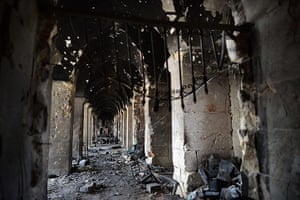
Aleppo mosque damage: Aleppo's iconic Umayyad Mosque in ruins
 Aleppo mosque in rubble. Photo source and ownership: Copyright (c) The Guardian. Share with attribution.

Damascus and Jerusalem  

Damascus is an important history location to Christians around the world; it was where God began to teach a new Jewish disciple of Jesus Christ and to call him to preach to the Gentiles. That was the apostle Paul, once known as Saul of Tarsus.

Let's pray for peace in Syria and for the displaced Christians and Muslims. The persecuted are Christians who resisted threats and fled for their lives due to their faith and the ongoing conflicts in Syria. Let us pray for places of safe asylum for all, until they can return home in peace.  May those who follow Christ be encouraged by those who meet, feed, and house them. 

Jerusalem was the city where Paul, who had persecutied the church as Saul, was at first under strong suspicion by church leaders. Jerusalem was where Paul was tested and accepted as a true believer, willing to suffer for the gospel. 

Let us pray for the peace of Jerusalem, beset on every side, yet helping Syrian refugees. Let us learn biblical teaching about Jerusalem, including prophecies, and watch and pray that all will be fulfilled.


     For, "In just a little while, he who is coming will come and will not delay." Hebrews 10:37


Saturday, June 16, 2012

Greece and Willing Surrender to Discovery

Steps
To climb to top of Mars' Hill. Photo Creative Commons License Nathan Gibbs.
One theme that attracts me is the natural elements that overflow with indications of willing surrender from which we can learn. This kind of surrender is not giving up or giving in. It is a yielding to what is intended to be the true state. Even hard stone surrenders to chipping, cutting, and even crushing, to make way or to make something fresh.

Surrender can be frightening, and willing surrender is even more so. Yet, from this yielding come many of life's extraordinary events and achievements.

The plain stone stairway (photo may not appear upper right at all times) leads upward to the site of a historic and spiritual place for Greek people. The stairway blends nature because it took form in industrious human hands. Greece's natural stone reflects variations of light and shade in a plan that moves in a narrowing and widening way, upward. These  humble stones lead to Athens' Mars' Hill, featuring idols and gods, such as Ares, Zeus, and Mars with altars to them, plus an altar to the unknown god.

Mars' Hill's altars attracted the attention of a first century follower of Christ, Paul of Tarsus, Syria, who climbed those stone steps to the top of Mars' Hill*. Having reached the top, Paul surrendered himself to what the place offered, points of discussion for the philosophers and debaters with him there.

He got to this place of philosophic discussion and debate because he had been waiting in Athens for friends that were traveling to join him there. Being an observant man, he took note of Athens' abundantly public references to idolatry and to the Athenians' love of debate and questioning. "His spirit was stirred within him," says the record,* and he began to converse in an Athenian synagogue with other Jews, his people, as well as people in the marketplace.  

Stoics, Epicureans, and others took note and began to interrogate him. They finally forced him to go with them up to Mars' Hill, a center for public debates and a place of altars to their gods. The more the philosophers continued to accuse and question Paul there, the more willingly he gave himself up to the opportunity to speak of God and His Son, the Christ, Χριστός, Christos. When he urged them to surrender willingly also to faith in God through Christos, many responded Yes. He had identified the unknown God, now knowable through the Son of the living God.  

Descendants of some who said Yes that day--such as Dionysius, a judge of the Aeropagus, and a woman named Damaris, and others" *--are among today's Christians of all of Greece (Athens, Corinth, and the other places), and Greek people who have migrated to other countries and regions.  

If Paul, earlier known as Saul, of Tarsus, had not willingly surrendered himself to Christ (Acts 9:1-19) and to the Holy Spirit's guidance that led him abroad, including to Athens and the stirring of his inner spirit there, much would have been missed, opportunity lost. Paul's willing submission to where he was and waiting for his friends led ultimately to Mars' Hill. The record of that time redounds to God's glory and faith among Greek people, culture, and history, and throughout the world of Christendom.   

We cannot become sure of realities without the searching that leads us forward and upward. Without willing surrender, we only think, imagine, speculate, wonder, suspect, debate, or doubt within tight limitations. We cannot enter into the discoveries beyond imagination that bring good change into individual lives and entire generations in the future.    

In Thessalonica, a  "great number of the devout Greeks and not a few of the leading women"* joined with Paul of Tarsus, later an apostle of Jesus Christ. Later, he wrote to his Greek brothers and sisters of faith--including those in Corinth, Colosse, and Thessalonica. He knew what they were going through, persecuted by the world of their towns and country. His letters were heartfelt. 

After willing surrender to the marvels of God, the next most wonderful is the willing surrender to love brothers and sisters in Christ and to grow in communion with them. 
___________________________________________

* Bible, book of Acts, 17th chapter; quoted words from The Amplified Bible

In this year 2012, Greece suffers  economic and social turmoil; those living in Greece who believe in the living Christ--as Paul and certain Mars' Hill hearers did ("many clung to him [Paul] and believed" **)--can discover more about faith, hope, and love as they walk with the living Lord today.This willing surrender to Χριστός, Christos, leads to discoveries yet to come. 

Today in Thessalonica (Thessaloniki), Greece: Mayor Yiannis Butaris, a chemist and oenologist (wine and wine-making expert), has expressed concerned confidence about possibilities for the city beyond present-day difficulties. Another example, I opine, of willing surrender to the tasks for purposes of discovery--how a people can make their city better for the long-term view.   

**--see Acts 17:34--King James Version of the Bible (KJV)  
About one Middle Ages Greek church

Text copyright (c)2012 Opinari Writers
Enhanced by Zemanta

Thursday, December 29, 2011

Harmony in 2012 for Christian Writers

HAPPY NEW YEAR GREETINGS!
--__A__--
Image by Amateur.Qin(秦) via Flickr
Jean Purcell
Twitter @opinaripeople

Twitter @OpineBookCafe_NEW 
"May this  SECOND DAY OF THE NEW YEAR be a day of thanks continuing for you!. I'm thinking what book to review for upcoming OpineCafeBlog."     
     
St. Augustine focused on the harmony needed between what we say and how we live. Anyone can write or say something profound or meaningful without in fact living it. Simply by writing well, do we do so as followers...of Christ? This is the measure of a year of work.      
     
An earlier follower of Christ than St. Augustine was the apostle Paul. God inspired him to write about love. Paul wrote, in essence, that the most heavenly-sounding words can only go so far as to shake the senses... if they are written or said apart from love. This message is inherent in the apostle's life. He wrote what is referred to, in the Bible, as I Corinthians 13, beginning: "If I speak in the tongues of men and of angels, but have not love, I am only a resounding gong or a clanging cymbal..."

Conclusion
Harmony for 2012
is ours as we seek the Lord of love. 
Isn't He our heart's main desire, the One who leads us? 

 In expectation, we seek harmony 
between our words and how we live, inside and outside,
in the love of God through Christ Jesus.

 LORD, we put all trust in You. 
Help us to pray. Help us to read Your holy written Word,
which feeds us. Help us, alone or with others, to help the poor...with love.  
We need Your help so that we can write
in the harmony that is possible by varieties of means and expressions.       
   Amen.


Copyright (c)2011 Opinari Writers
Enhanced by Zemanta