Showing posts with label Christians. Show all posts

Tuesday, September 22, 2015

SYRIA - Hearts go out to the country of Paul's day


A zealot, Saul of Tarsus, in Jerusalem

In the first century when Jesus was born, a devout Orthodox Jew journeyed from Jerusalem's persecution of Christians to Damascus (Syria) to persecute more Christians. On the way the Lord confronted him. It was a conversion like all conversions to Christ--individual, unique, highly personal and transforming.

Paul, saved by God, goes to Arabia

Later, this man, once called Saul and then Paul as a devoted follower of Jesus Christ, went to Jerusalem and was not accepted by the apostles, because as Saul he had persecuted Christians.

He left for Arabia to study in what some call the school of the Holy Spirit. What was "Arabia" to Paul? N. T. Wright, in Paul, Arabia, and Elijah (Galatians 1:17) proposed that "Paul went where Elijah went. He went to Mount Sinai .... The word 'Arabia' is very imprecise in Paul's day, covering the enormous area to the south and east of Palestine; but one thing we know for sure is that for Paul 'Arabia' was the location of Mount Sinai."(See paragraph 11 in N.T. Wright article linked above.)

Mount Sinai, also called Mount Horeb, is on the Sinai Peninsula of Egypt. If N.T. Wright's reasoning is correct, that is where Paul went, that triangular, arid, desert region of Egypt, between the Mediterranean Sea and the Red Sea.

Paul travels back to Damascus

From Arabia, Paul returned to Damascus: "In the Galatian letter in 1:17-18 Paul clearly states that upon his return from Arabia he came back to the city of Damascus. Exactly how long Paul’s stay in Arabia lasted is not clear, but combined with his return visit to Damascus was a period of three years." (Tracing the Steps of Paul)

His visit to Caesarea, then Syria

Next, Paul went to Jerusalem, then Caesarea. Then, again, he went into Syrian regions:

"... Upon Paul’s departure from Caesarea, Luke tells us in Acts 9:30 that he was sent forth to Tarsus. It would be logical to conclude on the basis of his route that on his way back home to Tarsus this is when he stopped by different cities and visited brethren in the Roman province of Syria. Paul referred to this in Galatians 1:21." (Tracing the Steps of Paul)

Consider the capital, Damascus, then and now

Some say that Damascus existed 1,000 years or more before the birth of Christ, surviving takeovers by different empires. Three hundred years before the birth of Jesus, Damascus was a large Muslim caliphate. By the time of Jesus' birth, the Roman Empire ruled Damascus. 

After the crucifixion of Jesus, and when Paul met Jesus on the road to Damascus, as recorded in the Acts of the Apostles, he could safely travel into Damascus; he was a Roman citizen. Damascus in those days was a thriving city of architectural, artistic, and trade interests.

The Christian community across Syria is one of the world's oldest, going back to the days of the Apostles. "... and there are Christians of today that speak Aramaic. In northern Syria, near the city of Aleppo, the historic Church of St Simeon Stylites stood...in the mountains west of Homs is the castle of Krak des Chevaliers, which was a fortress for the Knights Hospitaller during the Crusades." The castle is now badly damaged, bombed by government jets after it was used as a base by rebels in Syria's civil war. (Middle East)


In 2015, in the Syrian province of Hassakeh in February, hundreds of Christians are feared to have been kidnapped by the militants. Senior Christian clerics have also been kidnapped by unknown gunmen. Suspicion for the abductions has fallen on the Nusra Front, al-Qaeda's Syrian affiliate. "While their community faces a clear threat from the extremists of the Nusra Front and Islamic State, Christian men have been fighting in the multi-layered conflict - either alongside Kurdish militias or alongside relatively secular rebel factions, or government forces." (Syria's beleaguered Christians)

Christian and Muslim Syrians 

The apostle Paul nurtured believers wherever he journeyed, including his travels through Syria. Christians today are descendants of millennia of Syrian believers in Jesus Christ. Only five years ago, Syrian Christians made up about 10%, or 4.4 million, of the country's population. 

During on-going war and fighting in and beyond Damascus, neighborhoods are made into rubble and many sites destroyed, including the Aleppo mosque, northern Syria, shown below, debris hanging and repair seeming to lie far into the future, if at all. 
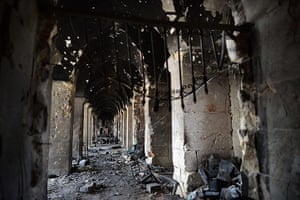
Aleppo mosque damage: Aleppo's iconic Umayyad Mosque in ruins
 Aleppo mosque in rubble. Photo source and ownership: Copyright (c) The Guardian. Share with attribution.

Damascus and Jerusalem  

Damascus is an important history location to Christians around the world; it was where God began to teach a new Jewish disciple of Jesus Christ and to call him to preach to the Gentiles. That was the apostle Paul, once known as Saul of Tarsus.

Let's pray for peace in Syria and for the displaced Christians and Muslims. The persecuted are Christians who resisted threats and fled for their lives due to their faith and the ongoing conflicts in Syria. Let us pray for places of safe asylum for all, until they can return home in peace.  May those who follow Christ be encouraged by those who meet, feed, and house them. 

Jerusalem was the city where Paul, who had persecutied the church as Saul, was at first under strong suspicion by church leaders. Jerusalem was where Paul was tested and accepted as a true believer, willing to suffer for the gospel. 

Let us pray for the peace of Jerusalem, beset on every side, yet helping Syrian refugees. Let us learn biblical teaching about Jerusalem, including prophecies, and watch and pray that all will be fulfilled.


     For, "In just a little while, he who is coming will come and will not delay." Hebrews 10:37


Monday, July 02, 2012

We Want Proof for Egyptians

President Barack Obama speaks at Cairo Univers...
President Barack Obama speaks at Cairo University. Public domain photo. Photo credit: Wikipedia

Commentary

Daniel Halper reported (Jun 24, 2012) the White House statement given by Press Secretary Jay Carney to convey President Obama's formal congratulations on the victory of the new president of Egypt, Dr. Mohamed Morsi. 

These words appear in the statement's  middle paragraph:

...We believe in the importance of the new Egyptian government upholding universal values, and respecting the rights of all Egyptian citizens – including women and religious minorities such as Coptic Christians. --Jay Carney/The Weekly Standard

President Obama did well to address legitimate concerns for the welfare and safety of women and minorities and to name the largest Christian group specifically. One looks to see if the new Egyptian leaders include all, evangelical and reformed Christians, in their promise of protections and rights. All of this will reassure nervous minorities and women otherwise likely to be persecuted.

In the past, Egyptian Christians have been persecuted in random acts, but protected, in general, by the Mubarak regime. Clearly, all Egyptian minorities--Christians and other non-Muslims, including former Muslims, and other minorities--should have full legal rights and protections in the new Egyptian form of democracy. That is especially basic for Egypt as it begins its own way in what it claims to be determined to do.

One of the largest groups of Coptic Christians lives in Fairfax, Virginia, about an hour's drive from my home in Maryland. I learned this from The Washington Post (July 2, 2012, Metro section B, 'Disaster is coming very soon,' by Pamela Constable). Christians in Fairfax are fearful for their friends and relatives in Egypt, many of whom hope to leave Egypt as soon as possible, due to fears of more persecution.

The Washington Post article reported that after the election a Christian woman was harassed in her town in Egypt when making an Internet payment. A clerk on duty said, "Next time come back with your head covered. Your time is over" (page B1, Wash. Post).

Claims of democracy set down constructive challenges and change for all leaders in Egypt, especially those of the Muslim Brotherhood. Their Muslim brothers in the U. S., as it turns out, have religious freedoms under law in the U. S., where they are a minority religious group.  

Clearly, the new president of Egypt will need to put to shame attitudes of aggressively intolerant and extremist groups. He is expected to lead and insist on radical changes for the better of all people of Egypt. Many believe that many Muslims want this too and should not fear speaking out and living their beliefs on basic rights of safety for all citizens.  

The U. S. President and State Department, as well as the U. S. Congress, should follow events carefully, using every intelligence means possible, and letting no time go by when or if strong response might be needed. Determined statements by U. S. spokespersons must be followed by necessary actions.

Similarly, UN statements, if not already forthcoming, should make clear that the issue of protected minority and religious freedoms are at the top of democratic agenda. 


The U. S. and the UN need to prepare "what if" scenarios and be ready to cut off aid swiftly, the millions the taxpayers of the U. S. give to Egypt. Any "good works" done through U. S. aid are negated whenever the U. S. is weak on religious rights.

Copyright (c)2012 Opinari Writers
Enhanced by Zemanta

Saturday, September 11, 2010

9/11-The Church that Stood, and Stands

2015/A.M.: MSNBC showed film from 9/11/01; FoxNews covered ceremonies in NYC, at the Pentagon, and in Pennsylvania. Others, business as usual during the critical hours of memorial.  FoxNews interviewed people on the scene at the Pentagon and in the White House, as well as NYC. 


2010: "New Yorkers and family members came to honor the victim's of 9/11. ...Four moments of silence were held at 8:46 and 9:03 a.m., when the planes hit the towers, and at 9:59 and 10:28 a.m., when each tower fell." (Source: MyFoxNY.com, 9/11/10-"The Little Church that Stood"-by Adrian Carrasquillo)


The 2008 article, "The Church that Stood, and Stands," first posted on SearchWarp.com, 9/11/2008, the seventh memorial year:

2008-Remembering St. Paul's Church - ("The Church that Stood, and Stands"-SearchWarp.com, 9/11/08-by Jean Purcell):

Soon after September 11, 2001, my husband and I were in New York City. We went  to Ground Zero, where the Twin Towers of the World Trade Center had recently stood strong, towering into the skies above the Hudson River. Now, we stood in a long snake-line of people paying respects, alongside a black iron fence enclosing a uniquely special church. In line,  people wore professional, sports, and casual clothes. As if it were a normal day. Patience and quiet stood in line, eerily on display, where normally there would have been rush and noise in the normal city routine.

Ground Zero view outside St. Paul's Chapel-trinitywallstreet.org

The black iron fence in front of the church immediately next door to the towers bore memorial ribbons, flowers, and photos, the latter placed in hopes of finding family or friends safe, not a victim of the deluge of steel, fire, and smoking dust. Also attached to that church fence were written prayers and poems. The church, which had, amazingly, stood intact through the tragedy of that morning of September 11, 2001, now provided unique comfort and hope outside, as well as within. for rescue workers, pastors, priests, rabbis, medical people, and others who love their fellowmen and what America stands for, a haven for prayers and free food and drink for exhausted Ground Zero workers during brief, dusty breaks.

Today is the seventh memorial year of that 9/11. The World Trade Center site pit, which marks that infamous attack by fanatic-driven aim in the skies over the Hudson River from Boston, shows signs of change, a memorial setting in progress. When the memorial opens, I hope visitors will notice the church that stands nearby, embraced by that iron fence that bore loving notices for a long, long time. If ever that church suffers a direct attack, it is a great comfort to know that the Church it represents, the body of faith led by Jesus Christ, will stand eternally.

Acts of terror and the ideology of those who took over four American airliners will not win. Our faith, hope, togetherness, and spirit of determination and devotion to freedom will remain victorious. Those who love, treasure, and seek to protect freedom will vanquish their ideology and their efforts. May God bless all who honor the memory of the helpless, the rescuers, and the comforters who died on 9/11/01. Like that church that stood and still stands alongside the site of the World Trace Center's Twin Towers, may we always be prepared to serve, comfort, and offer hope to others.
"And as Moses lifted up the serpent in the wilderness, even so must the Son of man be lifted up: That whosoever believes in him should not perish, but have eternal life. For God so loved the world, that he gave his only begotten Son, that whosoever believes in him should not perish, but have everlasting life. For God sent not his Son into the world to condemn the world; but that the world through him might be saved" (John 3:14-17). 

2001 -St. Paul's Church, next to the Trade Center site, went into action to serve food and water and provide brief relief and prayers for firefighters, medical rescue teams, police, and others...On that fateful day of reverberating shocks, America suffered multiple human loss at: World Trade Center Twin Towers, North and South, NYC; the Pentagon, VA, just outside Washington, DC; a farm field in PA. We do not deny. We do not forget. We remember the victims of terrorism that died that day, and the brave living who lost  yet went forward, due to their love.  
Enhanced by Zemanta