Showing posts with label writing style. Show all posts

Friday, June 15, 2012

My Style of Writing_Writ Shorter

English: Sources of Allt Mharconaich Meeting G...
"...Going north from Coire Mharconach watershed I was so glad to find a watercourse to follow as the going was rough going."(Wikipedia) Opinari Writers: A writer's landscape may have bumpy, dry, and isolated places; it's good to remember its hidden streams, verdant spots, blue sky, and light.
English: Dean Batali teaching at writing meeting.
Dean Batali...at writing meeting. (Wikipedia)
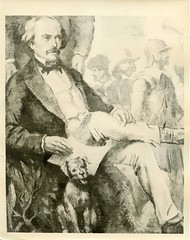
Pageant of American Literature, Hawthorne study
Pageant of American Literature, Hawthorne study (CT State Library)
Words have a power all their own
Words have a power all their own (Lynne Hand)
Words
Words (sirwiseowl)
Russian writer Sergey Lukyanenko meets his rea...
Moscow: Sergey Lukyanenko meets his readers. (Wikipedia) Opinari Writers: I write about other writers and events from around the world.
Writer's Stop
(Stephh922)
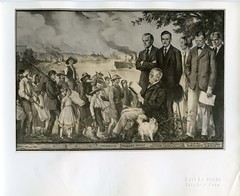
Pageant of American Literature, view 3
Opinari Writers: American heritage in writing (and steamboat in background), painted by Karl La Roche, Stamford, Connecticut (CT): Wm. Dean Howells (seated), Robert Frost, Edna St. Vincent Millay, Eugene O'Neill, Carl Sandburg,  Sinclair Lewis, and a local audience. Remembering the reader connection. Pageant of American Literature, view 3 (CT State Library)  
It's time to state--in 150, 75, 50, and 25 words--what I do as a writer. 


Two versions of my Final Statement (word-count goal up to 25 words)

Second version of Final Statement of "what I do": 

I report and probe for avid readers of commentary on history, literature, politics, writing, religion. 

First version of Final Statement:  
I report, inquire, and probe for avid readers of commentary (history, literature, politics, and/or religion) that includes biblical background or interpretation.
JP_In all statements prior to the final-final, I forgot how much I also write about aspects of writing, an obvious topic! I remedied this in the final-final. We can easily forget the obvious, right?

Cutting and trimming of text are invaluable options that help writers "write shorter." The final statements  developed from the longer versions, equally helpful to my thinking about this self-driven exercise, which i encourage writers to do and update: 

40 words or fewer
I am a column writer for avid, busy readers with interests in news and events commentary, as well as history, literature, politics, and/or religion. I mention biblical sources in most articles. I like to report, inquire, and probe.   

75 words or fewer
I am a nonfiction writer in the public square. I write for an audience with a layperson’s eye to history, literature, politics, and religion. Sometimes, I write commentary.

I calmly question, probe, and report briefly for avid, busy readers. I try to present differently something happening close to home or far away. When I need to use researched material, I supply one or more sources, with biblical sources used often.

Started here @140-word maximum
I am a nonfiction writer wanting good space in the public square. I write for an audience interested in another perspective with an eye to history, literature, politics, and religion; I often include biblical references for open-minded readers. Increasingly, I write commentary.

I like to question, probe, and report briefly on a range of topics for avid readers on the go. There’s a wide range of subjects and themes I might want to cover, some more than once. I keep in the back of my mind how to present differently.

What catches my writer's eye can be happening close to home or far away; it's whatever I want to shine a light on in some to-be-determined, but fast, way. When I need to quote or use researched material, I supply one or more sources.  

-30-

________________________________________________________________________________
For your writing style statement, experimentation helps, I think. It can begin, as done here, with 140 words and end with 25 words or less. Let me know how it goes, if you experiment with this too. I use the word "style" because it includes foresight, intention, imagination, concrete materials, and formation.
________________________________________________________________________________

Text Copyright (c)2012 Opinari Writers

Saturday, September 24, 2011

Woodward and Bernstein Editing Skills for Watergate

The writers that do not need editors keep journals and private writings for themselves or to share in letters, e-mails, or blogs.

Writers that need editors are columnists, article writers, book authors and any other writer, such as in-house writing for organizations or business...anyone whose work is for publication.

Reporters have editors, of course, and we take for granted that this includes the best, prize-winning reporters. Two reporters untangled the Watergate story that kept the political world in Washington, DC, glued to their features in The Washington Post. Every day. For months. 

Robert Woodward and Carl Bernstein became more famous when their book about Watergate, All the President's Men, came out of film production starring Robert Redford and Dustin Hoffman.  

Remember who was Bob Woodward's most consistent and frequent editor?

Writers know words and thoughts and how they should fit together for specific genres to create reliable and interesting reading. Editors know these things too, perhaps in more detail, and definitely with the unique advantage of objectivity. Editors, therefore, bring what works to help bring readers to the easy chair, sofa, table or computer, Kindle or Nook, with attention glued to a writer's words and pages, whether nonfiction or fiction.  

Editing goes beyond grammar, spelling, and structure of language...sentences and paragraphs. Part of good editing is the ability to analyze writing projects, especially books, for direction and flow from beginning to end. 

No matter what genre a book fits into, readers expect some enjoyment or satisfaction from the process, even from the most serious book topics. There must be redeeming aspects within a work. In fiction, this can come through minor characters. However it comes, it is essential. These and other ingredients an editor looks for, with an objective eye. The good writer has more inside him or her, usually, than a manuscript displays before editing. Editors seek to help uncover that yet-to-be-expressed skill or insight that the writer can yet reveal.  

All of us love to finish a book feeling satisfied, even if shocked by how the story ended or how it was resolved. We want to feel that the writer did not set us up, but gave an adventure of imagination, people (real or fictional), and story. 

Remember who edited much of Bob Woodward's writing at The Washington Post when he and Carl Bernstein were hounding the Watergate story? Remember how Bernstein started their relationship, in fact, by taking an article out of a pile and editing it...at his typewriter, of course?

This brief overview of how editors can help writers improve might encourage a writer out there to welcome an editor, rather than dread "what might happen to" the work. What could happen could be even much better than the writer realizes...and that will come to the surface through a good writer-editor relationship. The editing process can enrich the skills and lives of both. 


Copyright (c)2011 Opinari Writers Network
Enhanced by Zemanta

Tuesday, June 29, 2010

Good writers pay attention to: 
Mission—The chief strains or threads of their promise to readers
Message—The writer zooms in on words capable of carrying the most helpful tone and meaning in ways that are clear, interesting, and reliable.
Motive—The invisible dynamic; self-indulgent writing lends weakness
Meaning—Factual and symbolic meaning that fits mission and message
Movement--The writer's personal reading habits show through. It has been said, for example, that Winston Churchill's oral cadence matched that of the psalms.


The Psalms of David - Choir of King's College, Cambridge - Sir David Willcocks, Sir Philip Ledger Praying the Psalms
Enhanced by Zemanta