Showing posts with label WWII. Show all posts

Thursday, January 03, 2013

Mother of Neuroscience: a life that inspires discovery

Rita Levi Montalcini, 20 april 2009
Rita Levi Montalcini, 20 april 2009 (Photo credit: Wikipedia)

Rita Levi Montalcini "began her seminal research on cell development while dodging bombs..." (Emily Langer/Washington Post).

A Washington Post obituary on 12/30/12 impelled me to shine a light on the life and work of Rita Levi-Montalcini. Her nerve growth discovery under-girds today's neuroscience experimentation. Her life touches difficult endeavors beyond science.
     Rita Levi-Montalcini (link video) died in Rome at age 103. I found a report that as late as 2009, aged 98 years, she lectured on her areas of work.  
     Rita  Levi-Montalcini "began her seminal research on cell development while dodging bombs...." wrote Emily Langer in the Washington Post. She was fleeing Nazi Germany's efforts to gather up select groups for persecution and, ultimately, death.  
     Rita Levi-Montalcini's discovery of "the nerve growth factor" led to a Nobel Prize. The nerve growth factor is "a naturally occurring protein that helps spark the growth of nerve cells.
    Significantly, her ground-breaking discovery grew from her research "in a makeshift bedroom laboratory during the war." It extended, after the war, to Washington University in St. Louis, USA.
     If there is something you or I wish to discover this year, I doubt that it has as much as, or more than, a challenge as the discovery of the nerve growth factor, which influences experiments to help people with nerve diseases or injuries. 
    I think the key to what kept her going was her drive toward discovery, no matter what context her work had to make do...a hiding place, a small location not at all obviously conducive to scientific discovery. 
    Yes, she had to have been brilliant. However, how often has brilliance not been enough. So much comes from the personality and grit of human beings. I think also of Maria Callas, whose voice coach once said she willed herself to take control of notes completely, otherwise, outside her range or abilities. 
    What the facts remind me is one of my favorite credos: We must know what we want to do and do it. (Didn't Nike come to the same conclusion?) It must also be something worth doing, something big enough to drive us to continue. It must not be something independent of money, status, or "the right conditions." It must include a huge hope or dream. It may be a secret aspiration that might last beyond ourselves to benefit the lives of loved ones or beyond. It usually does not come from disconnected impulse. 
     The summary of Rita Levi-Montalcini's life inspires me. Her discovery continues to matter and to guide nerve research. I think it mean far more to her than perfection of place or conditions.   


"...there is no great a thrill as the moment of discovery."
Rita Levi-Montalicini (Nobel Prize/Medicine, "mother of neuroscience")*


*"mother of neuroscience" appears in photo description uploaded to Flickr by audrey.

Join this blog, or Tweet , G+ recommend, or comment on FaceBook.  

Copyright (c) 2013 Jean Purcell and Opinari Writers blog.
Enhanced by Zemanta

Tuesday, May 31, 2011

Gerald C. Primm and Charles H. Spurgeon

World War II Distinguished Flying Cross
Died on Memorial Day Weekend 2011
A devoted son, brother, husband, father, and grandfather
A devoted Christian and pastor

Faith takes the telescope, looks beyond the narrow range of time into the eternal heavens, and sees a crown laid up for the faithful.  
C. H. SPURGEON, THE MOURNER'S COMFORTER

"...what God has done with one life totally committed to Him whose power is unlimited!"  
GERALD C. PRIMM on C.H. SPURGEON

Gerald C Primm (1922-2011) To me, sister of Gerald Primm, the quotes above apply to my dear, oldest brother of my two treasured brothers, Gerald and Bud. Gerald Primm was a co-laborer for Christ and across time with Charles Haddon (C. H.) Spurgeon, and he was an expert on Mr. Spurgeon's life, works for the poor, preaching, and writing. Gerald went to be with the Lord early on the morning of May 28 at Moses Cone Memorial Hospital in Greensboro, NC. His sons were with him. Gerald was a beloved son (of Waldo Primm [d. 1984] and Treva Caudle Primm [d.1995]), husband (to Ethel Brown Primm [d.2006]), father (to John, Mark, and daughter-in-law Sandy), grandfather (to Carly, Caleb, Corrie, and Connor), brother (to Bud, Jean, brother-in-law Jim), uncle (to Deirdre and Carole), and friend; he was a pastor, mentor, preacher, and scholar; a WWII P-38 Lightning fighter pilot and veteran with many combat awards, he received the Distinguished Flying Cross, an award that most of the family knew nothing about until near or after his death.  
Capt. Gerald Primm
Mr. Primm greatly admired the person and works of 19th century London preacher C. H. Spurgeon (1834-1892), possibly above all other Christian men and preachers. He drew much strength from Mr. Spurgeon's perseverance of faith. Mr. Primm's new wife introduced him to Mr. Spurgeon not long after they married and through one book she suggested he read during a time of boredom when he wanted some good reading at a retreat. "Where can I find more books by this man?", Mr. Primm asked his bride after he finished the first book by Charles H. Spurgeon. Thus, the journey of a lifetime began. Mr. Primm even revived Sword and Trowel, a periodical Mr. Spurgeon published for many years. 

In his later years, Mr. Primm noted that his birth date, January 31, was the same as Mr. Spurgeon's date of death, and that Mr. Spurgeon's birth date, June 19, was the same birth date as Mr. Primm's sister, with whom he published the second US edition of The Mourner's Comforter.
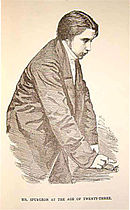
Charles H. Spurgeon age 23 (Wikipedia)

In 1975, the book's centennial year, Mr. Primm published the first U.S. edition of C.H. Spurgeon's 1875 publication The Mourner's Comforter, seven discourses on Isaiah 61:1-3; he compiled selections from Spurgeon's works in Paradoxes, Mysteries, Riddles, and Comfort for Christians (2002), which he edited; and he co-released a new edition of The Mourner's Comforter in 2007, based on the original,, with his Acknowledgments to Errol Hulse (UK) and others. 

One of the two largest collections in the world of Mr. Spurgeon's books and other works, including consecutive editions of "Sword and Trowel," were in Mr. Primm's personal library in his home. Mr. Primm collected the works gradually during decades of correspondence and book exchanges in the U.K. and elsewhere with rare book finders and dealers. Information about Mr. Primm's C.H. Spurgeon collection may be found, in future, through the library archives office (present archivist, Mr. Jim Lutzweiler) of Southeastern Baptist Theological Seminary-SEBTS, Wake Forest, NC. 

Paradoxes, Mysteries, Riddles, Enigmas, and Comfort for Christians: A Compilation of Selected Charles H. Spurgeon?The Mourner's Comforter: Isaiah 61 ExplainedThe Sword and the Trowel; Ed. by C.H. Spurgeon

Monday, November 08, 2010

Writers: Veterans Day, This November 11, What Did You Write?

A bagpiper with the U.S. Naval Academy Pipes a...Image via Wikipedia


What did you write about Veterans Day if you know no one who is a veteran?
If you know no one who is now in Iraq, Afghanistan, or elsewhere?
If you know no one who is now in one of the training institutions, like West Point, US Naval Academy at Annapolis, MD, or the Air Force or Coast Guard academies, or the Marines? The answer is obvious, isn't it? Do you appreciate freedom won for nations by the sacrifices and shed blood of others?

Professional writers do research for fiction, news columns, and other purposes. Special days like Veterans Day are a time to pay attention and do the research.

Thankfully, my brother Gerald returned home near the end of the war, having flown more than the maximum number of combat missions in his (second) P-38 Lightning fighter. Yes, I am proud of his service during WWII. I was old enough to pick up the quiet feelings in our home, to remember the service star in our front door window, and to remember the photos taken of my mother when he sent flowers for her birthday. American services organizations helped veterans to send special gifts or notices to family, as well as mail, and they were able to keep in touch on special days. I remember my mother crying then smiling on such a gift occasion. Although I was in preschool, the impressions remained.

It honors veterans and their families whenever a writer honors their service, no matter what they did. Military cannot function without fighters and also without those who are part of provisions and other logistics, as well as medical teams.

It will mean a lot to families of military now if you write on some "angle" of service, including how the family support helps each person in service. Write about the families. Encourage the children. Let them know how much their loved one's service means to this country.

What did  you write?

Enhanced by Zemanta

Tuesday, June 22, 2010

Love and Revenge-Personal Narrative genre


Her genre is personal narrative. Her story is about love's freeing power, told in her book that includes photos of her with other internationally-known journalists. She reflected upon this quote after her ordeals of World War II in the Pacific:

Peace is sweeter to those who have known the true meaning of war.


At the Eternal Light War Memorial on Corregidor island, Mamerta de los Reyes Block meditated on these words inscribed:  

No traveler who comes here sees the magnificent monument and stands unawed;...  
Sleep my sons, your duty done 
For Freedom's light has come. 
Sleep in the silent depths of the sea or in your bed of hallowed soil Until you hear at down the low, clear reveille of God.

Her WWII captors thought her dead when they dumped her in a heap of corpses. They neither knew nor cared about her, the new life within her, or her widowhood due to murderous occupiers. A respected Philippine journalist, she amazingly survived that pile of death. She bore a baby daughter, Aida, and then did physical labor as a detainee. 

After peace came to her island home, she continued journalistic work; she also met and married a US Ensign, Isaac Block, stationed at Subic  Bay, Philippines. She did not seek revenge against her tormentors, but rather adjusted proactively to post-war life. She moved to Washington, DC, where she and her husband rented a large house known as The House on 19th Street, which gave temporary refuge to exiles coming from war-torn parts of the world.

She never forgot the details of cruel and courageous people; of military powers abused and love's powers applied; of betrayals and sacrifices; of downtrodden people relying on faith to survive. She wrote her story, a Philippine story that reverberates everywhere.  

She said of her treasured freedom: "And yet, I still have occasional flashbacks of torture and sudden deaths of loved ones. It is only God's love that can heal."

Her personal narrative ends: 
Charity (love)
Beareth all things, Believeth all things,
Hopeth all things, Endureth all things.
Charity never faileth.
(I Corinthians 13)

(c)2003 Block, Mamerta de los Reyes, The Price of Freedom: The Story of a Courageous Manila Journalist, Trinity Rivers Publishing, Manassas, Virginia USA  

http://www.washingtonpost.com/wp-dyn/content/article/2005/03/25/AR2005032508813.html