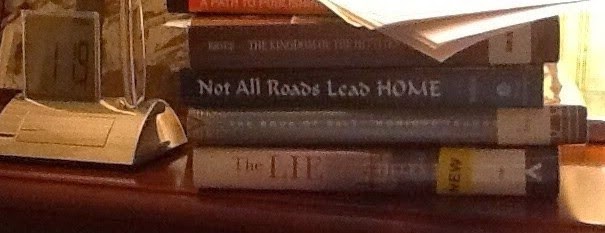
Over a period of 14 years (five of those in boxes) my personal narrative manuscript, Not All Roads Lead Home, developed. There were times when I wondered if it would be. When a British publisher took the manuscript, for different reasons I asked him to use my pen name.
Now Jim writes his book, one of complex times, participants, decisions to be made, and well-planned action taken. The matter of dire situations across continents during and prior to the late 1970s to early 1990s seems like a cleansing wildfire to be tamed.
People Jim has reconnected with and people he has met during this process, especially this year, reinforce the magnitude of the work, to tell about U.S. and international partnerships formed on behalf of refugees around the world in one timeframe.
We are away this week to work on the big picture now in draft form, after multiple rewrites. His is the way of authorship, and it is, as they say, wide and deep. I appreciate so much the help of others, offered in the desire to see the Work finish, and finish well.
When I have photos of the wall- posted poster sheets of each day's work plan, maybe I will post some of those. It's time, I think, to get my hands on a digital camera rather than turn to phone cam. :) However, this is his work, and to write about it is not his style. I am excited about it, as one seeing it form.
Hope you have a great day, not judging the day but living in it!
My News & Views
Showing posts with label writing. Show all posts
Showing posts with label writing. Show all posts
Wednesday, May 21, 2014


Thursday, December 12, 2013
Essays: Creative Writing about Favorite Things
Try an essay about something special to you.
Writers develop writing skills by tackling the simple essay, which is a short work of writing about a topic that intrigues or fascinates the essayist. An essay can be and often is a means of influence, encouragement, or inspiration.
The most important actions for developing an English essay are to decide on a clear and manageable theme and to create a basic outline that fits the needs of the essay's development. Generally, the outline can have only a few parts:
I. Brief and interesting theme statement, something introductory about a subject
A. Paragraph with information about the theme and/or reasons for the writer's enthusiasm about the theme
B. Paragraph with a fitting example of A; can include also the writer's experience or enthusiasm
II. Closing statement or paragraph to bring the above parts together in a succinct and interesting way
A good beginning and ending are like the appetizer and the dessert that complement an entree that satisfies expectation and taste with nourishment to build up the entire body. Without interesting ideas on the pages we read, we soon miss the spark that fresh information brings or the mental nourishment of a good idea or story.
Paragraph resource
Wednesday, June 27, 2012
Nora Ephron (1941-2012) Delightful in Words
 |
| Ephron at right_Seven Second Delay - Live @ UCB Theater 9/23/09 (Photo credit: jvdalton) |
Writer and dramatist Nora Ephron left the world scene yesterday from a NYC hospital where loving family and friends stayed close by, at her passing. What they will miss--borrowing words from her writing--is her visible presence and interaction in their lives. What many of us will miss, from a distance, is just knowing she's here and writing. We have enjoyed her person and words, sharing characters and places, bringing stories to life in hilarious, gentle, and suspenseful ways.
Nora Ephron gave much of herself through autobiographical narratives, dialogues, monologues, and stories. We, admirers of her talent and of her, feel sad that long illness did cut off her life and writing; yet, she gave no hint of question or complaint, at least in public, where she shared much of her life, yet never without humor to help us get through the bad with her. She did not complain, but cryptically, it now seems, revealed some hints of illness in her last book, where she thanked her doctor. It's something one might do after a successful operation, so gave even colleagues no reason to guess that her message meant more.
Watching her movies and news about her life through the years and from a distance, it seemed that she always closely entwined her life and her writing. She never seemed to hide herself from getting on with either. In spite of the heartburn of heartbreak, she moved from Washington, DC, to New York City with two young children (now adults) to start anew. Part of her heartache in the nation's capital included personal items about her ending marriage, much of it splashed in The Washington Post's sometimes too-clever Style section due to her husband's too-public personal actions.
She raised her boys and also married again. She kept working, of course, and her writing stabbed our hearts, hearts that so willingly permitted the joyous worries we shared vicariously with "When Harry Met Sally, "Got Mail," "Sleepless in Seattle," and many more you surely remember, if you're a fan. And of course you are, too!
She raised her boys and also married again. She kept working, of course, and her writing stabbed our hearts, hearts that so willingly permitted the joyous worries we shared vicariously with "When Harry Met Sally, "Got Mail," "Sleepless in Seattle," and many more you surely remember, if you're a fan. And of course you are, too!
Big movie names were made all the more shining than ever through close proximity to any of her works, humorous takes on young love, often, which everyone can be drawn to. I believe there are similarly talented and funny and serious writers, as yet unfound or not quite yet having found the space, time, and exact groove. I hope for that one, at least, to keep working on their own special ways of delighting people on paper and in the movies. When one such writer's road ends, we need another, at least one, to help us laugh in somewhat the same warm, teary, entertaining ways.
Some of us feel a sharp stab when writers think that obscenities and blasphemies can pass for writing or humor, a sharp stab when writers fill spaces with slush rather than a thesaurus search. Nora Ephron may have allowed her characters to speak unthinkingly due to their fictional clueless-ness, in ways we might not do, but not due to writing done without care.
You could tell she waited to find the best words and combinations that drew her. Not perfect writing (whose is?): Ultra-exceptional writing meant to entertain us in our times.
Writing this, I feel timid moments coming on: What if I'm using some phrase she detested, some simple linking of words that made her shudder? Would she, if she read them, be anything but tolerant about that? What do you think?
It's selfish, but I'm longing for fresh delightful, shining moments that say she's still here. Countless thoughts go with and prayers are for the family and friends of the special person. Nora Ephron's words remain with us, and the movies. Don't forget the movies.
Here are some Nora Ephron book titles: Crazy Salad, Heartburn (also movie),
I Feel Bad About My Neck: And Other Thoughts on Being a Woman, Scribble Scribble, I Remember Nothing: And Other Reflections
Copyright (c)2012 Opinari Writers
Friday, June 15, 2012
My Style of Writing_Writ Shorter
 |
| "...Going north from Coire Mharconach watershed I was so glad to find a watercourse to follow as the going was rough going."(Wikipedia) Opinari Writers: A writer's landscape may have bumpy, dry, and isolated places; it's good to remember its hidden streams, verdant spots, blue sky, and light. |
 |
| Dean Batali...at writing meeting. (Wikipedia) |
 |
| Pageant of American Literature, Hawthorne study (CT State Library) |
 |
| Words have a power all their own (Lynne Hand) |
 |
| Words (sirwiseowl) |
 |
| Moscow: Sergey Lukyanenko meets his readers. (Wikipedia) Opinari Writers: I write about other writers and events from around the world. |
 |
| (Stephh922) |
 |
| Opinari Writers: American heritage in writing (and steamboat in background), painted by Karl La Roche, Stamford, Connecticut (CT): Wm. Dean Howells (seated), Robert Frost, Edna St. Vincent Millay, Eugene O'Neill, Carl Sandburg, Sinclair Lewis, and a local audience. Remembering the reader connection. Pageant of American Literature, view 3 (CT State Library) |
It's time to state--in 150, 75, 50, and 25 words--what I do as a writer.
Two versions of my Final Statement (word-count goal up to 25 words)
Second version of Final Statement of "what I do":
I report and probe for avid readers of commentary on history, literature, politics, writing, religion.
First version of Final Statement:
I report, inquire, and probe for avid readers of commentary (history, literature, politics, and/or religion) that includes biblical background or interpretation.
JP_In all statements prior to the final-final, I forgot how much I also write about aspects of writing, an obvious topic! I remedied this in the final-final. We can easily forget the obvious, right?
Cutting and trimming of text are invaluable options that help writers "write shorter." The final statements developed from the longer versions, equally helpful to my thinking about this self-driven exercise, which i encourage writers to do and update:
40 words or fewer
I am a column writer for avid, busy readers with interests in news and events commentary, as well as history, literature, politics, and/or religion. I mention biblical sources in most articles. I like to report, inquire, and probe.
75 words or fewer
I am a nonfiction writer in the
public square. I write for an audience with a layperson’s eye to history,
literature, politics, and religion. Sometimes, I write commentary. I calmly question, probe, and report briefly for avid, busy readers. I try to present differently something happening close to home or far away. When I need to use researched material, I supply one or more sources, with biblical sources used often.
Started here @140-word maximum
I am a nonfiction writer wanting good space in the public square. I write for an audience interested in another perspective with an eye to history, literature, politics, and religion; I often include biblical references for open-minded readers. Increasingly, I write commentary.
I like to question, probe, and report briefly on a range of topics for avid readers on the go. There’s a wide range of subjects and themes I might want to cover, some more than once. I keep in the back of my mind how to present differently.
What catches my writer's eye can be happening close to home or far away; it's whatever I want to shine a light on in some to-be-determined, but fast, way. When I need to quote or use researched material, I supply one or more sources.
-30-
________________________________________________________________________________
For your writing style statement, experimentation helps, I think. It can begin, as done here, with 140 words and end with 25 words or less. Let me know how it goes, if you experiment with this too. I use the word "style" because it includes foresight, intention, imagination, concrete materials, and formation.
________________________________________________________________________________
Text Copyright (c)2012 Opinari Writers


Friday, March 09, 2012
Author Jane Bullard Answers via YouTube
 |
| One of Jane's favorites_ Image by Puzzler4879 via Flickr |
Not All Roads Lead Home author, Jane Bullard |
| Photo (c) 2005-2012 From Video |
Thursday, December 29, 2011
Harmony in 2012 for Christian Writers
HAPPY NEW YEAR GREETINGS!
In expectation, we seek harmony

 |
| Image by Amateur.Qin(秦) via Flickr |
Jean Purcell
Twitter @opinaripeople
Twitter @OpineBookCafe_NEW
"May this SECOND DAY OF THE NEW YEAR be a day of thanks continuing for you!. I'm thinking what book to review for upcoming OpineCafeBlog."
Twitter @OpineBookCafe_NEW
"May this SECOND DAY OF THE NEW YEAR be a day of thanks continuing for you!. I'm thinking what book to review for upcoming OpineCafeBlog."
St. Augustine focused on the harmony needed between what we say and how we live. Anyone can write or say something profound or meaningful without in fact living it. Simply by writing well, do we do so as followers...of Christ? This is the measure of a year of work.
An earlier follower of Christ than St. Augustine was the apostle Paul. God inspired him to write about love. Paul wrote, in essence, that the most heavenly-sounding words can only go so far as to shake the senses... if they are written or said apart from love. This message is inherent in the apostle's life. He wrote what is referred to, in the Bible, as I Corinthians 13, beginning: "If I speak in the tongues of men and of angels, but have not love, I am only a resounding gong or a clanging cymbal..."
Conclusion
Harmony for 2012
is ours as we seek the Lord of love.
Isn't He our heart's main desire, the One who leads us?
Isn't He our heart's main desire, the One who leads us?
In expectation, we seek harmony
between our words and how we live, inside and outside,
in the love of God through Christ Jesus.
in the love of God through Christ Jesus.
LORD, we put all trust in You.
Help us to pray. Help us to read Your holy written Word,
which feeds us. Help us, alone or with others, to help the poor...with love.
We need Your help so that we can write
in the harmony that is possible by varieties of means and expressions.
which feeds us. Help us, alone or with others, to help the poor...with love.
We need Your help so that we can write
in the harmony that is possible by varieties of means and expressions.
Amen.
Copyright (c)2011 Opinari Writers
Thursday, November 10, 2011
Personal Narrative Writing and Childhood
 Image via Wikipedia
A personal story with little mention of childhood would be hard to find. Our personal stories, because they are about our lives, naturally grow out of early hopes and expectations. There were also fears that became part of us. I like to honor the dreams and hopes that arose from childhood. Also, I treasure the realization of having overcome certain normal fears of childhood and youth.
The first edition of my personal narrative, Not All Roads Lead Home, included influences of childhood that went with me into adult life. I thought I was writing about adult experiences. I did not know how powerful childhood and youth memories would be or the benefit of revisiting them. There were no tragic incidents to recall, thankfully, but there were hurts, surprises, and disappointments, of course, for "thus is life." Influences of strong events affect us uniquely, for a while, maybe a lifetime, yet maybe with changing perspectives.
I discovered during writing the book that after weeping through pages of writing one could feel lighter and more free. In a couple of instances, it seemed the writing time allowed a good settling or release in heart and mind. Clearer and more mature understanding and interpretation began to form...or so it seems.
It's unclear to me whether or not we need to plan to include childhood or youth memories in personal narratives about grown up times, but I don't think we need to plan it. In my experience, what we are to share will come forth, to us, as we write. Then, we can consider and reflect how and how much to integrate of those memories. I think we can trust this.

The first edition of my personal narrative, Not All Roads Lead Home, included influences of childhood that went with me into adult life. I thought I was writing about adult experiences. I did not know how powerful childhood and youth memories would be or the benefit of revisiting them. There were no tragic incidents to recall, thankfully, but there were hurts, surprises, and disappointments, of course, for "thus is life." Influences of strong events affect us uniquely, for a while, maybe a lifetime, yet maybe with changing perspectives.
I discovered during writing the book that after weeping through pages of writing one could feel lighter and more free. In a couple of instances, it seemed the writing time allowed a good settling or release in heart and mind. Clearer and more mature understanding and interpretation began to form...or so it seems.
It's unclear to me whether or not we need to plan to include childhood or youth memories in personal narratives about grown up times, but I don't think we need to plan it. In my experience, what we are to share will come forth, to us, as we write. Then, we can consider and reflect how and how much to integrate of those memories. I think we can trust this.

Copyright (c)2011 Jean Purcell and Opinari Writers
___________________________________________
A writing quote: "Be obscure clearly." ~E. B. White

Thursday, November 03, 2011
Tony Hillerman's Example-Write what you know
 Cover of Seldom Disappointed: A Memoir=photo in New Mexico
by Jean Purcell
editor@opinebooks.com
Follow on Twitter @opinaripeople
My husband and I have read every Tony Hillerman (d. 2008) fiction book, and we have watched two Hillerman movies. Finally, when the author's memoir, Seldom Disappointed, was released, I bought it and found interesting tales about writing and life, along with good humor, advice, and insight for writers and fans.
Tony Hillerman became a best-selling author published in many languages. He lived in New Mexico, the scene of his crime novels. At the beginning of his attempts to sell his book manuscripts to publishers, however, a literary agent advised him to drop his Navajo context and characters. "Readers are not interested. It won't sell," was the general point. In his writing memoir, Seldom Disappointed, Hillerman told the story. Ironically, then, readers came to love this new author of Leaphorn and Chee books. Robert Redford made two movies based on HarperCollins books about the fictional Navajo detectives.
Hillerman is not the only author to be encouraged to change directions. How did he know to follow his instincts instead of professional opinion, which he did not easily cast off. The experienced agent was giving professional advice. Yet, in Hillerman's case, it did not fit. Who could know?
A key writer's mantra, "Write what you know," surely helped in this author's life. Like many other authors, he knew the landscape, life, and people that he wrote about. Throughout his career, he was honored not only with writing awards but also with a special Navajo Nation award.
"For all the recognition he received, Mr. Hillerman once said, he was
most gladdened by the status of Special Friend of the Dineh (the Navajo
people) conferred on him in 1987 by the Navajo Nation. He was also proud
that his books were taught at reservation schools and colleges." ( source: New York Times)
Copyright (c)2011 Opinari Writers Network
Related articles
Saturday, September 24, 2011
Woodward and Bernstein Editing Skills for Watergate

The writers that do not need editors keep journals and private writings for themselves or to share in letters, e-mails, or blogs.
Writers that need editors are columnists, article writers, book authors and any other writer, such as in-house writing for organizations or business...anyone whose work is for publication.
Reporters have editors, of course, and we take for granted that this includes the best, prize-winning reporters. Two reporters untangled the Watergate story that kept the political world in Washington, DC, glued to their features in The Washington Post. Every day. For months.
Robert Woodward and Carl Bernstein became more famous when their book about Watergate, All the President's Men, came out of film production starring Robert Redford and Dustin Hoffman.
Remember who was Bob Woodward's most consistent and frequent editor?
Writers know words and thoughts and how they should fit together for specific genres to create reliable and interesting reading. Editors know these things too, perhaps in more detail, and definitely with the unique advantage of objectivity. Editors, therefore, bring what works to help bring readers to the easy chair, sofa, table or computer, Kindle or Nook, with attention glued to a writer's words and pages, whether nonfiction or fiction.
Editing goes beyond grammar, spelling, and structure of language...sentences and paragraphs. Part of good editing is the ability to analyze writing projects, especially books, for direction and flow from beginning to end.
No matter what genre a book fits into, readers expect some enjoyment or satisfaction from the process, even from the most serious book topics. There must be redeeming aspects within a work. In fiction, this can come through minor characters. However it comes, it is essential. These and other ingredients an editor looks for, with an objective eye. The good writer has more inside him or her, usually, than a manuscript displays before editing. Editors seek to help uncover that yet-to-be-expressed skill or insight that the writer can yet reveal.
All of us love to finish a book feeling satisfied, even if shocked by how the story ended or how it was resolved. We want to feel that the writer did not set us up, but gave an adventure of imagination, people (real or fictional), and story.
Remember who edited much of Bob Woodward's writing at The Washington Post when he and Carl Bernstein were hounding the Watergate story? Remember how Bernstein started their relationship, in fact, by taking an article out of a pile and editing it...at his typewriter, of course?
Remember who edited much of Bob Woodward's writing at The Washington Post when he and Carl Bernstein were hounding the Watergate story? Remember how Bernstein started their relationship, in fact, by taking an article out of a pile and editing it...at his typewriter, of course?
This brief overview of how editors can help writers improve might encourage a writer out there to welcome an editor, rather than dread "what might happen to" the work. What could happen could be even much better than the writer realizes...and that will come to the surface through a good writer-editor relationship. The editing process can enrich the skills and lives of both.
Copyright (c)2011 Opinari Writers Network

Tuesday, February 01, 2011
 Image via Wikipedia
If you have never visited Washington, D.C., you are missing out on a fabulous experience. Plan a trip there and allow our country to come alive before your very eyes. You won't be sorry.- Pat Brannon, author, commenting on this blog's July 4 post, 2010.
And this is the time to make and set up plans to visit Washington in the Spring of 2011. Plan a trip for the Cherry Blossom Festival, 2011! March 26-April 10. and take notes for a few articles or your blog or web site. If you write about history or governance, what better place than the US capital city?
I think that visitors like Pat, quoted above, see the city with fresher, more appreciative eyes than those of us who live nearby. However, we do not want to take for granted this beautifully designed city. It is a city of marble, of ancient Gothic and Roman architecture, of engravings from treasured documents and speeches, and of giants of this country whose service, life-stories, faith, and words dominate the history that permeates so much of the capital city. Who has documented the numbers of the many books and movies based on this city of history, dreams, and power, intended for good? This is inspiring territory for writers like Pat Brannon, who writes poetry and stories, for grownups and children, respectively.


 Pat Brannon is a writer working within schools to help children confront difficult problems, such as bullying, through drama and humor that talks straight.
Related articles
- Washington D.C. Prepares For Cherry Blossom Gawking Season (luxist.com)
- Ten great Washington D.C. restaurants (gadling.com)


 Ask your librarian about these titles. Support booksellers and public libraries - Opinari [to think, reason, believe]
Friday, December 17, 2010


Friday, September 24, 2010
Be True: Op-Ed Impact with Appeal
 Art Buchwald image via Wikipedia

The best, most lasting op-ed writers build their reputations on reliability--sticking to balanced facts, referring to evidence on both sides, making clear arguments, with examples, as powerfully as possible and without intentional distortion.
Art Buchwald, co-author of The Art of Column Writing (see book cover graphic, above) made his views and observations known humorously and unforgettably. I sometimes stood on the opposite side of his conclusions, yet I always enjoyed his work.
Mr. Buchwald knew well the art of likeability joined with honesty and frankness. There was no sign of the bitter write who tends toward fact-bending. This prolific writer never showed bitterness and kept his fans' attention from the first line to the last.
Aim to keep your readers' interest for a long time; help them want to read more, even if they don't always share your views. Argue the facts you know fairly. Inform and entertain in your own style. Keep developing your style. All along the way, you might even change some opinions. (Op-ed writing links are on this page, right column.)
Read "Trains, Airplanes, and Cars" - BELOW.

Thursday, September 23, 2010
"Airplanes,Trains, and Cars"-This Title Would Not Have Made It
"Airplanes, Trains, and Cars" could have been a title for this movie, but could not have brought the smooth-fitting tempo it deserved. And, it could not have fit the two unifying and high-level comedic performances that bring this story home. Steve Martin and John Candy deftly pilot, chug, and drive home this comedy of climate and technology foibles, complicated by the unpredictable human elements. "Planes, Trains, and Automobiles" fits these actors' tempo. Within the framework of snowstorm and seemingly endless transportation glitches, life dumps on their characters trying to get home for Thanksgiving...in spite of each other. Martin and Candy lead this hilarious story to its moving end--with comic misdirection via planes, trains, and cars...er, automobiles.

![Planes Trains & Automobiles [VHS]](https://lh3.googleusercontent.com/blogger_img_proxy/AEn0k_vB3hVdVezKcYnnhdnl_y2T_-ggdWEwhBS3jIgl_kkudda2dcuTwxjFsFnNZ7SjQ7zkA3LlftTnW--OV0kPawcQtys3Bs6VtnDQ-SlITVDCUbGiuF3fKyVzUhBWPfHLzMeL9Q8hBqCyQGmil7OwVyb0W_PnaPkFp6gb4cjVBgfX38WrPiJdbGrDJpyEdNqLIz8eNXP2ysCSWcaLaOMvJgGkjR4xS4Gt-A=s0-d)


 |
| Titles matter. |
Subscribe to:
Posts (Atom)