Showing posts with label Writer. Show all posts

Friday, June 15, 2012

My Style of Writing_Writ Shorter

English: Sources of Allt Mharconaich Meeting G...
"...Going north from Coire Mharconach watershed I was so glad to find a watercourse to follow as the going was rough going."(Wikipedia) Opinari Writers: A writer's landscape may have bumpy, dry, and isolated places; it's good to remember its hidden streams, verdant spots, blue sky, and light.
English: Dean Batali teaching at writing meeting.
Dean Batali...at writing meeting. (Wikipedia)
Pageant of American Literature, Hawthorne study
Pageant of American Literature, Hawthorne study (CT State Library)
Words have a power all their own
Words have a power all their own (Lynne Hand)
Words
Words (sirwiseowl)
Russian writer Sergey Lukyanenko meets his rea...
Moscow: Sergey Lukyanenko meets his readers. (Wikipedia) Opinari Writers: I write about other writers and events from around the world.
Writer's Stop
(Stephh922)
Pageant of American Literature, view 3
Opinari Writers: American heritage in writing (and steamboat in background), painted by Karl La Roche, Stamford, Connecticut (CT): Wm. Dean Howells (seated), Robert Frost, Edna St. Vincent Millay, Eugene O'Neill, Carl Sandburg,  Sinclair Lewis, and a local audience. Remembering the reader connection. Pageant of American Literature, view 3 (CT State Library)  
It's time to state--in 150, 75, 50, and 25 words--what I do as a writer. 


Two versions of my Final Statement (word-count goal up to 25 words)

Second version of Final Statement of "what I do": 

I report and probe for avid readers of commentary on history, literature, politics, writing, religion. 

First version of Final Statement:  
I report, inquire, and probe for avid readers of commentary (history, literature, politics, and/or religion) that includes biblical background or interpretation.
JP_In all statements prior to the final-final, I forgot how much I also write about aspects of writing, an obvious topic! I remedied this in the final-final. We can easily forget the obvious, right?

Cutting and trimming of text are invaluable options that help writers "write shorter." The final statements  developed from the longer versions, equally helpful to my thinking about this self-driven exercise, which i encourage writers to do and update: 

40 words or fewer
I am a column writer for avid, busy readers with interests in news and events commentary, as well as history, literature, politics, and/or religion. I mention biblical sources in most articles. I like to report, inquire, and probe.   

75 words or fewer
I am a nonfiction writer in the public square. I write for an audience with a layperson’s eye to history, literature, politics, and religion. Sometimes, I write commentary.

I calmly question, probe, and report briefly for avid, busy readers. I try to present differently something happening close to home or far away. When I need to use researched material, I supply one or more sources, with biblical sources used often.

Started here @140-word maximum
I am a nonfiction writer wanting good space in the public square. I write for an audience interested in another perspective with an eye to history, literature, politics, and religion; I often include biblical references for open-minded readers. Increasingly, I write commentary.

I like to question, probe, and report briefly on a range of topics for avid readers on the go. There’s a wide range of subjects and themes I might want to cover, some more than once. I keep in the back of my mind how to present differently.

What catches my writer's eye can be happening close to home or far away; it's whatever I want to shine a light on in some to-be-determined, but fast, way. When I need to quote or use researched material, I supply one or more sources.  

-30-

________________________________________________________________________________
For your writing style statement, experimentation helps, I think. It can begin, as done here, with 140 words and end with 25 words or less. Let me know how it goes, if you experiment with this too. I use the word "style" because it includes foresight, intention, imagination, concrete materials, and formation.
________________________________________________________________________________

Text Copyright (c)2012 Opinari Writers

Thursday, November 10, 2011

Personal Narrative Writing and Childhood

girl, writingImage via Wikipedia
by Jean Purcell
Twitter @opinaripeople

A personal story with little mention of childhood would be hard to find. Our personal stories, because they are about our lives, naturally grow out of early hopes and expectations. There were also fears that became part of us. I like to honor the dreams and hopes that arose from childhood. Also, I treasure the realization of having overcome certain normal fears of childhood and youth.  
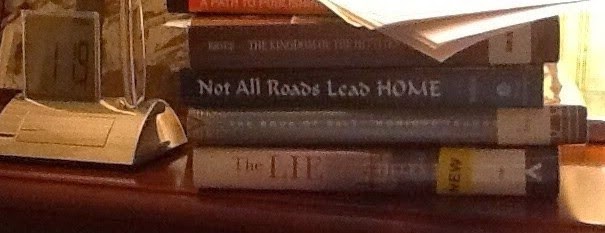
    The first edition of my personal narrative, Not All Roads Lead Home, included influences of childhood that went with me into adult life. I thought I was writing about adult experiences. I did not know how powerful childhood and youth memories would be or the benefit of revisiting them. There were no tragic incidents to recall, thankfully, but there were hurts, surprises, and disappointments, of course, for "thus is life." Influences of strong events affect us uniquely, for a while, maybe a lifetime, yet maybe with changing perspectives.  
     I discovered during writing the book that after weeping through pages of writing one could feel lighter and more free. In a couple of instances, it seemed the writing time allowed a good settling or release in heart and mind. Clearer and more mature understanding and interpretation began to form...or so it seems.
     It's unclear to me whether or not we need to plan to include childhood or youth memories in personal narratives about grown up times, but I don't think we need to plan it. In my experience, what we are to share will come forth, to us, as we write. Then, we can consider and reflect how and how much to integrate of those memories. I think we can trust this.
           
Copyright (c)2011 Jean Purcell and Opinari Writers
 ___________________________________________

A writing quote: "Be obscure clearly." ~E. B. White

Enhanced by Zemanta

Wednesday, October 05, 2011

Personal Narrative is personal and First-person Narrative is fictionally so

There is a need to clear up any confusion about the difference between a personal narrative and a first-person narrative.
     Personal narrative usually refers to a true story or recounting of events, giving form and interpretation about one's personal experience and perspectives on it. Personal narratives are nonfiction, also called memoir or autobiography (when the story covers the life, not one central time of life).  The one who experienced the events is telling the story, a personal story of immense personal proportions, enough to push the writer to tell it. One of my favorites is the very experienced and illustrious writer, now deceased, Eudora Welty, whose works are a remarkable legacy. Her personal narrative is her memoir, One Writer's Beginnings.

     First-person narrative usually refers to the perspective of the teller of a story told as fiction. The observer and/or participant of the novel, for example, is telling the story. The Sense of an Ending is fiction written in first person. I cannot comment further, not having read it. Maybe I will soon. You can read about in on Amazon.com, where there are numerous reviews. 
     Otherwise, fiction requires a straight narrative told by  the "hidden" speaker, the writer. One follows words to follow multiple characters and events. Unlike the first-person, there are few limitations on time and place and characters involved.
     Some fiction writers show the main character's perspective in straight narrative, telling the character's thoughts and impressions. After all, the writer knows the character. Other character perspectives can be shown, in one book or story, usually in separate chapters or sections.


Copyright (c)2011 Jean Purcell and Opinari Writers. Permission to quote or use with attribution.


Copyright (c)2011 Opinari Writers Network
Enhanced by Zemanta