
Showing posts with label Syria. Show all posts

Tuesday, September 22, 2015

SYRIA - Hearts go out to the country of Paul's day


A zealot, Saul of Tarsus, in Jerusalem

In the first century when Jesus was born, a devout Orthodox Jew journeyed from Jerusalem's persecution of Christians to Damascus (Syria) to persecute more Christians. On the way the Lord confronted him. It was a conversion like all conversions to Christ--individual, unique, highly personal and transforming.

Paul, saved by God, goes to Arabia

Later, this man, once called Saul and then Paul as a devoted follower of Jesus Christ, went to Jerusalem and was not accepted by the apostles, because as Saul he had persecuted Christians.

He left for Arabia to study in what some call the school of the Holy Spirit. What was "Arabia" to Paul? N. T. Wright, in Paul, Arabia, and Elijah (Galatians 1:17) proposed that "Paul went where Elijah went. He went to Mount Sinai .... The word 'Arabia' is very imprecise in Paul's day, covering the enormous area to the south and east of Palestine; but one thing we know for sure is that for Paul 'Arabia' was the location of Mount Sinai."(See paragraph 11 in N.T. Wright article linked above.)

Mount Sinai, also called Mount Horeb, is on the Sinai Peninsula of Egypt. If N.T. Wright's reasoning is correct, that is where Paul went, that triangular, arid, desert region of Egypt, between the Mediterranean Sea and the Red Sea.

Paul travels back to Damascus

From Arabia, Paul returned to Damascus: "In the Galatian letter in 1:17-18 Paul clearly states that upon his return from Arabia he came back to the city of Damascus. Exactly how long Paul’s stay in Arabia lasted is not clear, but combined with his return visit to Damascus was a period of three years." (Tracing the Steps of Paul)

His visit to Caesarea, then Syria

Next, Paul went to Jerusalem, then Caesarea. Then, again, he went into Syrian regions:

"... Upon Paul’s departure from Caesarea, Luke tells us in Acts 9:30 that he was sent forth to Tarsus. It would be logical to conclude on the basis of his route that on his way back home to Tarsus this is when he stopped by different cities and visited brethren in the Roman province of Syria. Paul referred to this in Galatians 1:21." (Tracing the Steps of Paul)

Consider the capital, Damascus, then and now

Some say that Damascus existed 1,000 years or more before the birth of Christ, surviving takeovers by different empires. Three hundred years before the birth of Jesus, Damascus was a large Muslim caliphate. By the time of Jesus' birth, the Roman Empire ruled Damascus. 

After the crucifixion of Jesus, and when Paul met Jesus on the road to Damascus, as recorded in the Acts of the Apostles, he could safely travel into Damascus; he was a Roman citizen. Damascus in those days was a thriving city of architectural, artistic, and trade interests.

The Christian community across Syria is one of the world's oldest, going back to the days of the Apostles. "... and there are Christians of today that speak Aramaic. In northern Syria, near the city of Aleppo, the historic Church of St Simeon Stylites stood...in the mountains west of Homs is the castle of Krak des Chevaliers, which was a fortress for the Knights Hospitaller during the Crusades." The castle is now badly damaged, bombed by government jets after it was used as a base by rebels in Syria's civil war. (Middle East)


In 2015, in the Syrian province of Hassakeh in February, hundreds of Christians are feared to have been kidnapped by the militants. Senior Christian clerics have also been kidnapped by unknown gunmen. Suspicion for the abductions has fallen on the Nusra Front, al-Qaeda's Syrian affiliate. "While their community faces a clear threat from the extremists of the Nusra Front and Islamic State, Christian men have been fighting in the multi-layered conflict - either alongside Kurdish militias or alongside relatively secular rebel factions, or government forces." (Syria's beleaguered Christians)

Christian and Muslim Syrians 

The apostle Paul nurtured believers wherever he journeyed, including his travels through Syria. Christians today are descendants of millennia of Syrian believers in Jesus Christ. Only five years ago, Syrian Christians made up about 10%, or 4.4 million, of the country's population. 

During on-going war and fighting in and beyond Damascus, neighborhoods are made into rubble and many sites destroyed, including the Aleppo mosque, northern Syria, shown below, debris hanging and repair seeming to lie far into the future, if at all. 
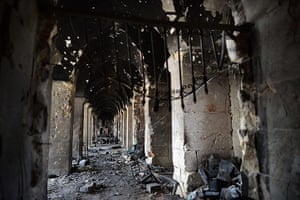
Aleppo mosque damage: Aleppo's iconic Umayyad Mosque in ruins
 Aleppo mosque in rubble. Photo source and ownership: Copyright (c) The Guardian. Share with attribution.

Damascus and Jerusalem  

Damascus is an important history location to Christians around the world; it was where God began to teach a new Jewish disciple of Jesus Christ and to call him to preach to the Gentiles. That was the apostle Paul, once known as Saul of Tarsus.

Let's pray for peace in Syria and for the displaced Christians and Muslims. The persecuted are Christians who resisted threats and fled for their lives due to their faith and the ongoing conflicts in Syria. Let us pray for places of safe asylum for all, until they can return home in peace.  May those who follow Christ be encouraged by those who meet, feed, and house them. 

Jerusalem was the city where Paul, who had persecutied the church as Saul, was at first under strong suspicion by church leaders. Jerusalem was where Paul was tested and accepted as a true believer, willing to suffer for the gospel. 

Let us pray for the peace of Jerusalem, beset on every side, yet helping Syrian refugees. Let us learn biblical teaching about Jerusalem, including prophecies, and watch and pray that all will be fulfilled.


     For, "In just a little while, he who is coming will come and will not delay." Hebrews 10:37


Monday, August 17, 2015

"Is anybody there?" - Syrian asylum-seekers

Does anybody care?

In Syria and beyond, turmoil continues, not least of it the fate of innocent citizens longing for peace and caught in the crossfire of warring parties. When help comes, it comes from humanitarian organizations and workers from non-warring parts of the world. The citizen workers also likely echo "Does anybody care?" It takes more than food and tents, the usual picture of refugees and displaced persons. It takes governments and policies, strategies and conviction followed by action. The United States should lead, as in the past, to make these innocents vitally important to the leaders of all non-warring countries looked to in the past. That is my view.

Here is part of the record that we, too, need to care about.

Today, attacks on asylum-seekers causes alarm in Germany.

Are Americans ignoring Syria's humanitarian crisis? Mort Abramowitz wrote that he thinks we are, and why he thinks so.

Similarly, "Who cares about Syria?" was Valerie Amos's opinion article in The Washington Post earlier.

Fred Hiatt wrote of a "defense of inaction in Syria," a provocative article about the record of current administration foreign policies.

Finally, but not least, is Thomas E. McMahon's letter to the Post in reaction to Valerie Amos's op-ed: How the U.S. can help Syria's citizens.

Thursday, August 29, 2013

Opinion-War on Syria

Jean Purcell

I never expected to write anything about the pros and cons of war. I hold neither pacifist nor hawk convictions. Rather, I agree with view that each situation needs to be evaluated in light of history and present to future reasons/justifications and expected consequences. 

The deeply jarring and shocking reports of victims of recent chemical weapon attacks, including babies and children, causes a reaction to lash out, to mete out punishment against the perpetrators and justice for the victims. The same when we see innocents hacked and killed as has happened in other places, where we have heard of the thousands slaughtered. 

Here are my top concerns that I hope others might consider regarding the present discussions here and abroad about attacking Syria: 
  • War is ugly, and we need that common sense saying kept in mind. If we could see live film/video of real people in the infernos of war, including innocents blown away while in their homes or shops...would we ever forget; would we not be forever so sickened that only a clear "must respond with more killing" (including likely civilian victims) would suffice? 
  • Have you known well any veteran who saw the front lines of war? I have, and he would never offer any comment about what he saw as a decorated war fighter pilot...I never heard him speak of war in specifics beyond a couple of close calls, where he survived. He knew war involves killing others. If we agree that war is horrific upon even the victors, then surely we know it is a heavy burden to carry.  
  • The U. S. (and international community, either) has not intervened in many places in the world where years of war have brutally hunted, hacked, and killed thousands upon thousands of innocent civilians. Rwanda, for example, comes to mind. More questions...
  1. What are the U. S. doctrine and laws about war?
  2. Why is the U. S. Congress not debating Syria with President Obama now? 
  3. Why is President Obama not responding to letters requesting meetings on attacks on Syria? 
  4. Is the U. S. Congress, in full membership or through foreign relations/affairs committees, so weak it cannot call for hearings on these matters? 
  5. Do we believe, with confidence, that strikes would prevent chemical weapons being used in the future, or even as a pause; can we be sure they would not be used even more viciously again and in the near future? Do we know where are other chemical weapons stockpiles that could be shipped into Syria? 
  6. In the present situation, are we aware of the refugee problems already ensuing and the suffering of many of weak resources in neighboring countries already over-burdened? (Could you or I, for example, absorb overnight 3,000 people on our property or in the neighborhood, each one needing to stay indefinitely, needing water, bathrooms, and food?) What about the increasing numbers likely to try to leave a Syria under attack? Are we planning to help them as they flee to Palestine, Egypt, Iraq, and elsewhere?
The British Parliament debates the Syria-attack option. It makes this American somewhat angry and saddened to see that body in full debate when nothing close to face-to-face debate or information is happening here, at home. Finally, if the U. S. decides to go and calls it an "intervention" or "humanitarian response" as euphemisms often serve so well today to cover reality...then we need to learn more, become better educated about what we are being told...or fed. 

These are a few thoughts and questions on my mind and, possibly, on your mind as well.  

2013 

Wednesday, August 28, 2013

Syria: U.S. Executive and Legislative powers avoiding "advise and consent" on War powers?

Jean Purcell
@OpinariPeople


I've been tweeting/twittering like crazy this a.m. over an (apparently) upcoming U.S. strike against selected targets in Syria, due to WMD/chemicals.

Americans need to think about our role in this. What is our role? Isn't it to expect the president to consult with congress?  That's my expectation, because I fear that strikes as a show of force will spark regional conflagration. We will, if not carefully considering what to do, provide ammunition, literally, for Syria's Assad and others to do more than many U.S. leaders are now imagining.  


Where, then, is/are the congress? On holiday? Unable to find a flight back to the capital city to get together with the president's men and women? Already back, but relatively quiet on this issue? Unaware of precedence for calling the president's men and/or women to the Hill to explain themselves and the president? 

What about the congressional foreign relations committees and their roles, to consult with the president, to use their powers to call hearings when military action clouds have formed already? (See a recent Washington Post report.) 

There is no cloud more deadly than a War Cloud full of weapons of destruction and ready to strike with or without a full deliberation.  

What about the region where Syria sits? What about the possibility of a spreading war? What about precipitating a reaction of horrors? There could be deadly retaliation in ways not yet believed likely or possible by western nations. 

The fear that chemical weapons use will spread is a legitimate fear. It is pushing a strong retaliation against Assad's regime, believed to be the source of the gassing of innocents recently in Syria. However...many parties need to be involved in the U.S. before we would impose outside, warring actions. But aggression is being planned, as announced or leaked. An American or coalition military display of anger and/or compassion can worsen the situation and never make it better. Aggressive action would be advertised in Syria, the region, and around the world as western aggression by unaffected interlopers gone wild. It would likely encourage more unwanted Arab action, i.e., terrorist groups outside Syria looking to infiltrate even further.     

Given the growing refugee populations in parts of Palestine, Egypt, and Iraq, one hopes the region and agencies are gearing up remarkably and that borders remain open. 

In my humble opinion, congress should be taking real action to find details of the president's plans and to make it clear that they are advising, as one, either by committees or full chambers. They need to formally communicate with American citizens. They should do more than talking and advising via news programs. At a minimum, congress and the president should be meeting face to face, which used to be the norm. They should be doing this now.

U.S. senate foreign relations committee-looking a bit hawkish on Syria  

U.S. house foreign affairs committee link here-speaking but not asking for meetings or hearings


Tuesday, July 23, 2013

Helping Children in Dire Need

Jean Purcell
Remembering the Good Samaritan..."In reply, Jesus said, 'A man was going...'" 

Commentary

I saw on today's news a powerful report about Syrian children displaced by war. They fled to Lebanon, where they exist in bare shelters as unwanted visitors—refugees. The news reporter said, “There is no light in their eyes, no smile on their faces.” 

How many years have we been hearing about Syria being torn apart by war? How many children have been awakened in the early night for a flight to safer Lebanon soil, hoping one day to return home? 

Neighboring Lebanon now speaks at times of a dislike for Syrians—adults and children—fleeing for their lives for shelter in Lebanon. Small, struggling Lebanon feels overwhelmed by the numbers needing refuge from a huge Syria. It seems that little more than geography connects the two mid-east countries. On a map, Syria takes up a lot of land and Lebanon, southwest, also borders Jordan, another refuge for war escapees.  

War thrusts survivors into life on an edge sharper than poverty and more deceptive than wealth. One Syrian girl of about 11, when asked by a reporter “What is life like here (the Lebanon camp where she lived)?,” answered, “Life?” Life seems to have disappeared into something else...exile and being unwanted. That is very different from life once safe at home, in her neighborhood, among friends.  

We hear such stories, and we want to do something. People that help children’s charities are able to carry hope and good news across their region and the world. Among groups rated by Charity Navigators*, you might consider these, to begin or to add to what you are already doing, from your heart:


*Charity Navigator has financial and management ratings and other information about hundreds of helping organizations


Copyright (c) 2013 Opinari Writers.

Monday, June 17, 2013

"Solving Syria"

Opinion


Mass Exodus from Northern South Vietnam: Image 3
FallofSaigon.org-Mass Exodus
Organizations and nations are discussing what might be a solution to end the civil war in Syria. From this American's perspective--and for reasons of humanitarian, geopolitical, and national resources, history, and/or religious interests--it is clear that influential Americans have different views. Those views usually include a disinclination to stay out of other regions' wars, a desire to see conflict, and its attendant suffering, end. 
     
Most Americans are war-weary and war-disillusioned. The solutions expected from going to war, since Korea, have not sufficed. I am not one to rush to a "war solution" view, and I think citizens and voters are weary of U. S. involvement in wars of recent years. As national puzzles grow, if there is a Syria Solution it is not appearing yet on thought-boards, charts, or known lists of acceptable options. 
    "Blood and treasure" is a phrase depicting the human costs of war. Groups like Wounded Warriors remind us of the severity of costs borne by combat survivors. They present a clear picture of "blood and treasure" through the faces, wounds visible and invisible, and families of fighters. We know their wounds could be ours or our families'...and some are.  
     In the 20th century, brain-trust names, presidential advisers, and Pentagon giants like Robert McNamara thought their analyses were correct. In his later memoirs, Robert McNamara wrote that he had long before realized that the Vietnam War, for which he had been a leading strategist, was "wrong, terribly wrong." 
     To leave dictators in place or to take them out has been an unanswered existential question of U. S. foreign policy. Where is the U. S. Congress regarding matters of advice and consultation? The second part of the war powers resolution, for example, reads that the President is required "to consult with Congress before introducing U.S. armed forces into hostilities or situations where hostilities are imminent, and to continue such consultations as long as U.S. armed forces remain in such situations (50 USC Sec. 1542)
     We cannot make other nations' civil wars or dictatorships our military business unless we are prepared with clear, imperative reasons able to past tests learned in U. S. recent  war history. The photo on this page, a mother and wounded child fleeing an overrun Saigon in 1975 when the U. S. was driven from Saigon, is a harsh, yet necessary, reminder that when we try out of fear or any reason not soberly considered, we may do more harm than good in the end. 
     The U. S. was attacked by four civilian planes turned into tools of terror on 9/11/01. Defending against another such attack and any attacks, smaller or larger, is our present war, at home and through intelligence abroad. That war continues, a different kind of combat. I care about Syria and the whole middle east, and they are subjects of prayer. Yet, I do not think we can solve these problems militarily.

(c) 2013 Opinari Writers blog

Saturday, June 16, 2012

Greece and Willing Surrender to Discovery

Steps
To climb to top of Mars' Hill. Photo Creative Commons License Nathan Gibbs.
One theme that attracts me is the natural elements that overflow with indications of willing surrender from which we can learn. This kind of surrender is not giving up or giving in. It is a yielding to what is intended to be the true state. Even hard stone surrenders to chipping, cutting, and even crushing, to make way or to make something fresh.

Surrender can be frightening, and willing surrender is even more so. Yet, from this yielding come many of life's extraordinary events and achievements.

The plain stone stairway (photo may not appear upper right at all times) leads upward to the site of a historic and spiritual place for Greek people. The stairway blends nature because it took form in industrious human hands. Greece's natural stone reflects variations of light and shade in a plan that moves in a narrowing and widening way, upward. These  humble stones lead to Athens' Mars' Hill, featuring idols and gods, such as Ares, Zeus, and Mars with altars to them, plus an altar to the unknown god.

Mars' Hill's altars attracted the attention of a first century follower of Christ, Paul of Tarsus, Syria, who climbed those stone steps to the top of Mars' Hill*. Having reached the top, Paul surrendered himself to what the place offered, points of discussion for the philosophers and debaters with him there.

He got to this place of philosophic discussion and debate because he had been waiting in Athens for friends that were traveling to join him there. Being an observant man, he took note of Athens' abundantly public references to idolatry and to the Athenians' love of debate and questioning. "His spirit was stirred within him," says the record,* and he began to converse in an Athenian synagogue with other Jews, his people, as well as people in the marketplace.  

Stoics, Epicureans, and others took note and began to interrogate him. They finally forced him to go with them up to Mars' Hill, a center for public debates and a place of altars to their gods. The more the philosophers continued to accuse and question Paul there, the more willingly he gave himself up to the opportunity to speak of God and His Son, the Christ, Χριστός, Christos. When he urged them to surrender willingly also to faith in God through Christos, many responded Yes. He had identified the unknown God, now knowable through the Son of the living God.  

Descendants of some who said Yes that day--such as Dionysius, a judge of the Aeropagus, and a woman named Damaris, and others" *--are among today's Christians of all of Greece (Athens, Corinth, and the other places), and Greek people who have migrated to other countries and regions.  

If Paul, earlier known as Saul, of Tarsus, had not willingly surrendered himself to Christ (Acts 9:1-19) and to the Holy Spirit's guidance that led him abroad, including to Athens and the stirring of his inner spirit there, much would have been missed, opportunity lost. Paul's willing submission to where he was and waiting for his friends led ultimately to Mars' Hill. The record of that time redounds to God's glory and faith among Greek people, culture, and history, and throughout the world of Christendom.   

We cannot become sure of realities without the searching that leads us forward and upward. Without willing surrender, we only think, imagine, speculate, wonder, suspect, debate, or doubt within tight limitations. We cannot enter into the discoveries beyond imagination that bring good change into individual lives and entire generations in the future.    

In Thessalonica, a  "great number of the devout Greeks and not a few of the leading women"* joined with Paul of Tarsus, later an apostle of Jesus Christ. Later, he wrote to his Greek brothers and sisters of faith--including those in Corinth, Colosse, and Thessalonica. He knew what they were going through, persecuted by the world of their towns and country. His letters were heartfelt. 

After willing surrender to the marvels of God, the next most wonderful is the willing surrender to love brothers and sisters in Christ and to grow in communion with them. 
___________________________________________

* Bible, book of Acts, 17th chapter; quoted words from The Amplified Bible

In this year 2012, Greece suffers  economic and social turmoil; those living in Greece who believe in the living Christ--as Paul and certain Mars' Hill hearers did ("many clung to him [Paul] and believed" **)--can discover more about faith, hope, and love as they walk with the living Lord today.This willing surrender to Χριστός, Christos, leads to discoveries yet to come. 

Today in Thessalonica (Thessaloniki), Greece: Mayor Yiannis Butaris, a chemist and oenologist (wine and wine-making expert), has expressed concerned confidence about possibilities for the city beyond present-day difficulties. Another example, I opine, of willing surrender to the tasks for purposes of discovery--how a people can make their city better for the long-term view.   

**--see Acts 17:34--King James Version of the Bible (KJV)  
About one Middle Ages Greek church

Text copyright (c)2012 Opinari Writers
Enhanced by Zemanta

Wednesday, June 13, 2012

Syria Solutions

English: Arab_League_(orthographic_projection)
English: Arab_League_(orthographic_projection) (Photo credit: Wikipedia)
Regarding Syrian children and adult civilians being used by government military as human shields:
     It takes more than a UN List of Shame.
It takes more than U.S. proclamations of disgust and disfavor. 
     It might need Arab League intervention efforts now. 10 PM/EST update_AL offer rejected by Syria_6/13/12.
     It might require what other civilian armies of civil wars have used --non-national military helpers.
     The U. S. Department of State is expressing formal concerns and, most recently, strong disfavor. Solid action is needed, yet what kind? Could it start, at the least, with independent U. S. end to military helicopters now going to Syrian government from Russia. Helicopters are made by the same supplier for U. S. military, Department of Defense, according to reports* on this under-reported part of the Syria story. Hillary Clinton does give U. S. endorsement for Arab League plan.  

The most pressing human issue is mostly on the ground, as civilians, including children, are being arrested, tortured, and killed by Syrian military, and others are used as human shields.
     Yet, the facts still are not convincing the above entities what is not only do-able but workable. One hopes for some brainstorm among the international leaders...aware of inevitable intensification with any action that might be taken. I have edited this more in effort to face the realities, while still hoping the powers might go beyond talk to some, even one, action to push against, to thwart, or to seriously damage. 

Many are praying for the people of Syria.

Note on another side: Opposition forces and Christians in Syria: Qusayr (Agenzia Fides) - The Christian Maurice Bitar was killed in Qusayr, near the town of Homs where the Christian population - about a thousand people out of 10 thousand who lived there before the beginning of the violence - has been forced to flee after the 'ultimatum launched by an armed faction in the opposition forces led by General Abdel Salam Harba (see Fides 09/06/2012).


Text copyright (c)2012 Opinari Writers
Enhanced by Zemanta